
St. John Projected Release Dates
Louisiana DPS&C uses the exact label “Projected Release Date.” Its automated locator provides the date if applicable. A projection applies the sentence, credit, earned-time rules, and other information then in the official record. It can be absent while time computation waits for signed court documents. It can also change after a correction, forfeiture, later sentence, or new hold. Only the holding agency can confirm the physical exit.
An actual release date records an event that has occurred. The St. John Sheriff roster can show a release timestamp for a person found through a prior “In Custody On” date. That value marks departure from the listed jail event, but it may describe a transfer rather than community release. The roster does not display release authority, reason, or destination. For that detail, contact Booking or request the release sheet and compare it with the court file.
| Date or event | What it means | Best source |
|---|---|---|
| Full-term date | The sentence endpoint before a qualifying reduction | Sentence and official time computation |
| Projected earned-time date | A current estimate after applicable credit rules | DPS&C locator or time computation |
| Parole eligibility or hearing | An opportunity for consideration, not a release | Statute and official parole docket |
| Actual jail exit | Departure from the named custodian | Release record and holding agency |
Find St. John Release Dates
Start by identifying legal custody. Lt. Sherman Walker Correctional Facility holds both parish and state inmates. The Sheriff roster’s “Held For Agency” field helps choose the next step. A local Sheriff entry points toward the 40th JDC sentence, jail credit, Booking Desk, and Sheriff Records Division. A Louisiana Department of Corrections entry calls for the state locator and LA VINE. Physical placement at Sherman Walker does not determine which agency computes the date.
The DPS&C inmate-information page explains the automated locator and its Projected Release Date output.
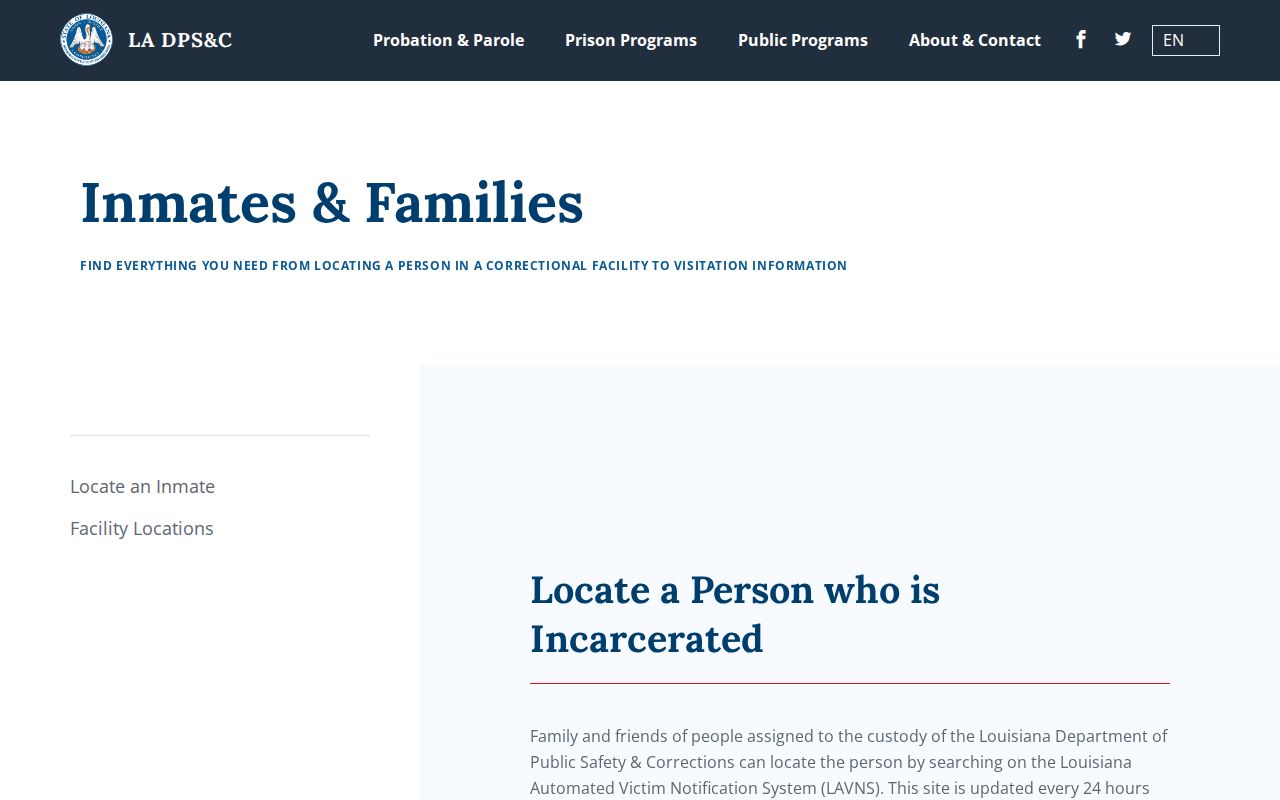
The captured state instructions confirm that the projection comes from the Louisiana corrections system and is supplied only when applicable.
- Confirm the custodian and held-for agency. Use the current Sheriff roster for local custody, and do not treat absence as release.
- For a state sentence, call the DPS&C automated locator at (225) 383-4580 with the DPS&C number or the person’s name and date of birth.
- If the state projection is missing, ask whether official sentencing papers have reached time computation. The information line is (225) 342-0799.
- For a parish sentence, obtain the 40th JDC sentencing minutes, commitment order, jail-credit ruling, offense date, and whether the sentence is with or without hard labor.
- Ask the responsible official for the calculation. Do not subtract a general percentage from the pronounced sentence.
- Near the expected date, verify actual custody with the holding agency and check for transfer, warrant, detainer, or later court action.
Note: A pretrial detainee has no earned-time projection from a final sentence; bond and court orders control that custody path.
St. John Release Calculation Delays
A projected date may not appear at once after sentencing. DPS&C states that official court paperwork must arrive before time computation can calculate the sentence. That may include sentencing minutes, the commitment order, and credit information. The automated system updates after the calculation becomes available. A missing field during that interval does not mean the person has no sentence, is due for immediate release, or has been discharged.
The DPS&C calculation FAQ documents the court-paperwork dependency and the need to let the official computation process finish.
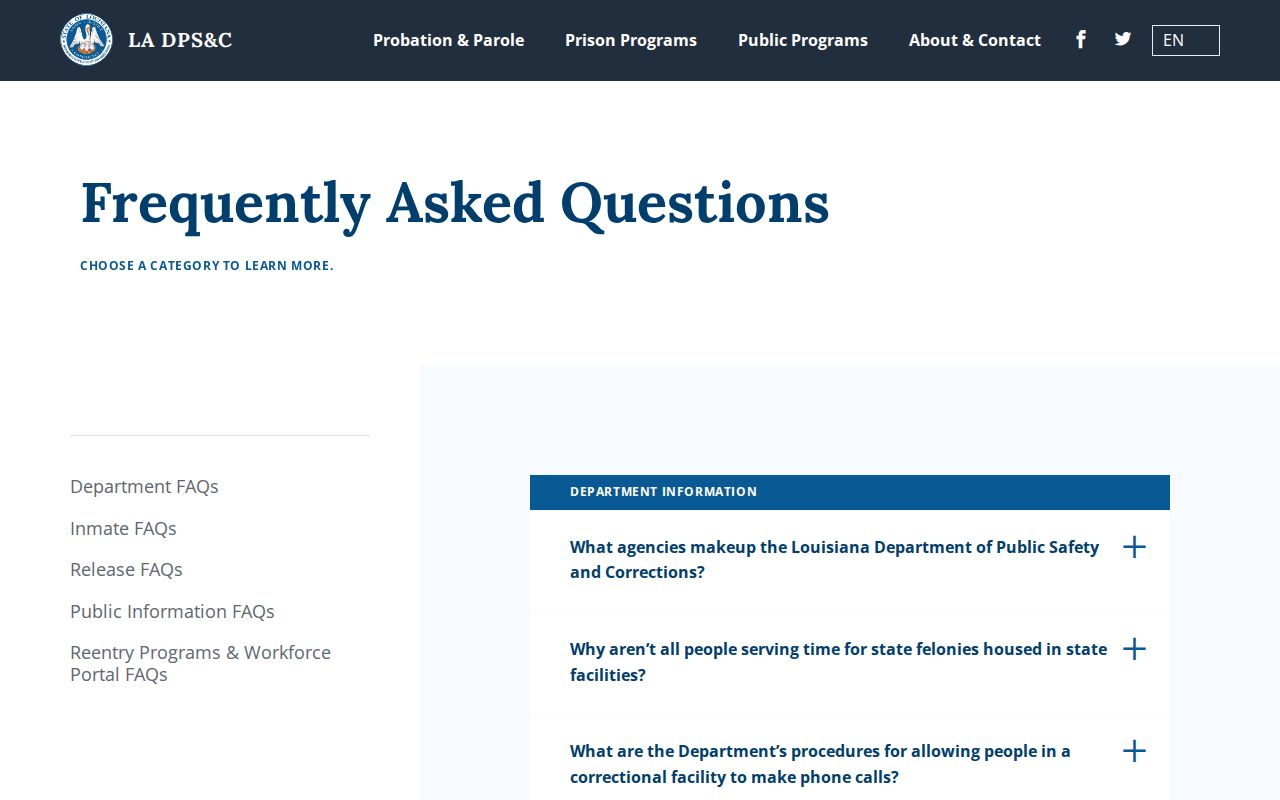
This official explanation is the key check when a St. John the Baptist Parish sentence exists but the locator has not yet posted a projection.
If the date looks wrong, collect the exact locator output and the underlying court papers before calling. The Clerk can address the accuracy of its signed record. DPS&C time-computation staff can explain the state calculation. A probation or parole officer supervises a person after release but does not set the release time. A public-records request also does not serve as an appeal or recalculation request.
Older St. John Good-Time Rules
For offenses before August 1, 2024, Louisiana R.S. 15:571.3 contains legacy diminution rules. Diminution means a sentence reduction earned under the governing law. A parish sentence without hard labor generally can earn 30 days of diminution for each 30 days actually served. The cited legacy rule for a first crime of violence uses three days for every 17 days actually served. State-felony formulas, exclusions, and offense categories can differ.
There is no valid universal percentage for older Louisiana cases. Violence, sex-offense, repeat-offender, and other rules can change eligibility. The sheriff or facility superintendent determines earned good time for qualifying parish confinement under the applicable framework. A state sentence follows DPS&C computation. The offense date matters because it selects the legal regime, while sentence terms such as “with hard labor” affect which custodian and rule apply.
- Diminution
- A reduction in time under a statute, often called good time.
- Jail credit
- Credit recognized for qualifying time already spent in custody.
- Forfeiture
- Loss of earned credit in circumstances allowed by law.
- Detainer
- A request or hold from another authority that may prevent an ordinary release.
Newer St. John Release Credits
For qualifying felony offenses committed on or after August 1, 2024, R.S. 15:571.3.1 generally allows up to 15 percent diminution in parish prison or DPS&C custody. This is the source of the shorthand that at least 85 percent is served. It is a maximum-credit framework, not a command to subtract 15 percent from every sentence. Sex offenses and habitual-offender sentences are excluded from that provision, and other statutory restrictions may apply.
The statute also says good time does not accrue against presentence credit under Code of Criminal Procedure article 880. Separate program credits may apply in some cases, and credit can be forfeited under R.S. 15:571.4. The Secretary has the relevant determination authority. These points make a personal hand calculation unsafe.
Release under the newer section generally places the person on unsupervised parole for the rest of the full term. A split sentence begins probation, with the unsupervised-parole period running as the statute directs. Legacy R.S. 15:571.5 uses a different “as if released on parole” structure with conditions and supervision. The two systems should not be merged.
The current diminution statute shows the post-2024 framework.
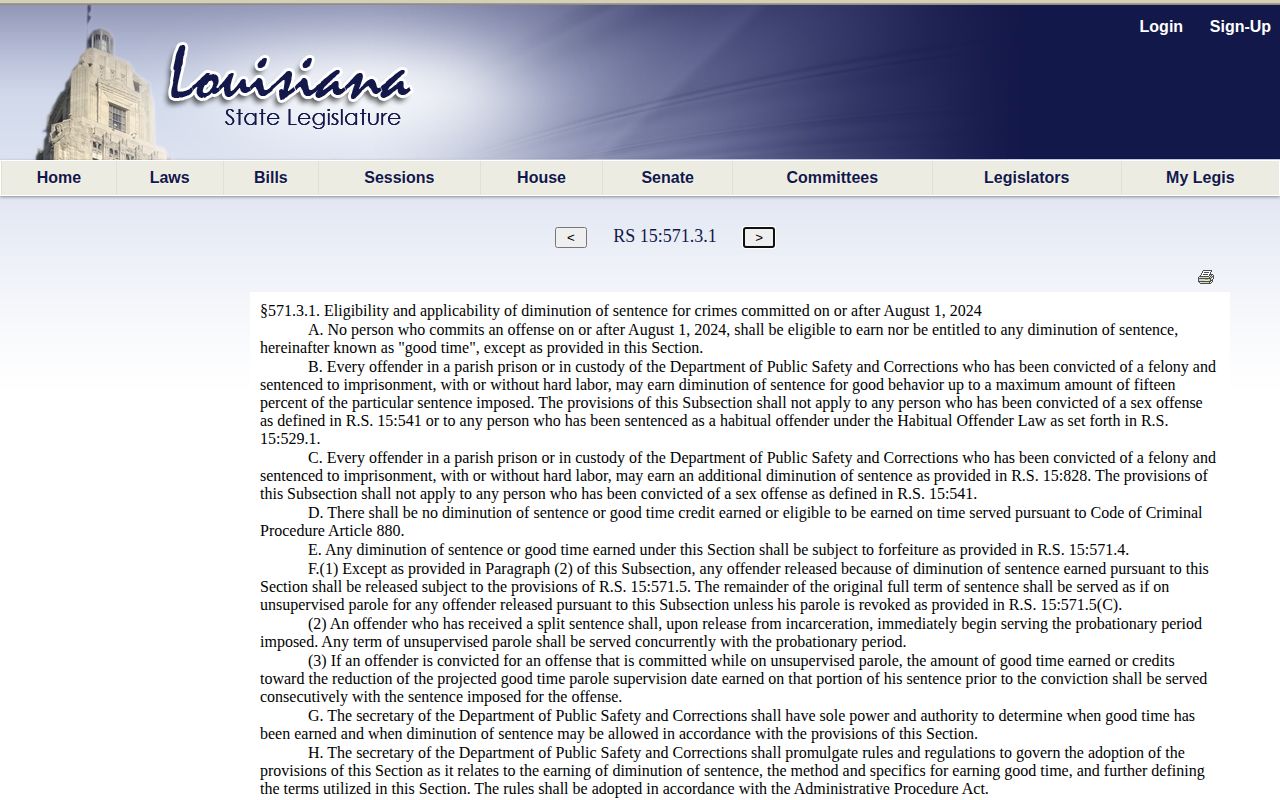
The statute image supports checking exclusions and credit rules in the source instead of applying the 85-percent shorthand to every case.
Note: Offense date, not the date someone happens to check the locator, determines which earned-time regime may govern.
Why St. John Release Dates Change
A projected date is built from a record that can change. Corrected credit may move it forward or back. Discipline can result in forfeiture under R.S. 15:571.4. A new conviction, consecutive sentence, amended judgment, delayed commitment document, or eligibility review can also alter the result. Even a sound calculation does not clear a warrant or detainer held by another authority.
| Factor | Possible effect | Who can verify it |
|---|---|---|
| Missing or corrected court papers | Delays or changes the calculation | 40th JDC Clerk and time computation |
| Jail-credit correction | Changes the credited time | Court record and computing agency |
| Earned-time forfeiture | Moves the projected date later | Responsible corrections authority |
| New or consecutive sentence | Adds time or changes the sequence | Sentencing court and DPS&C |
| Warrant or detainer | May block community release or cause transfer | Holding and requesting agencies |
| Parole action | May permit, deny, defer, or rescind consideration | Official Board docket and DPS&C |
A hearing date is not a release date. Eligibility only opens the chance for consideration. A grant still requires processing and can be affected by conditions or another hold. For many post-August 2024 commitments, R.S. 15:574.22 broadly removes parole eligibility except for listed categories. Older fractions under R.S. 15:574.4 do not compute an earned-time date.
Concurrent and consecutive sentences also require care. Concurrent terms run at the same time to the extent the judgment allows, while consecutive terms run in sequence. A single date copied from one case may therefore omit another controlling sentence. The 40th JDC docket, commitment order, and DPS&C computation should describe the same set of cases before the projection is relied on. If they do not, identify the mismatch instead of choosing the earliest date.
Confirm St. John Actual Release
As the projected date approaches, check the same agency that holds the person. For a state prisoner, use the DPS&C locator and LA VINE, then confirm with the listed facility. A state person may be physically housed at Sherman Walker, so also inspect the local historical roster after the event. If its held-for agency is Louisiana Department of Corrections, a release timestamp can be a transfer to another state facility rather than a community exit.
For a parish detainee or parish sentence, call the Booking Desk at (985) 359-8622 or (985) 359-8623. Ask whether the person left to the community or another custodian and request the release authority and destination where public. The 40th JDC docket supplies the legal order, while the jail record supplies the processing time. The broader St. John release-record lookup helps reconcile those two sources.
Where notification registration is available, the VINE Inmate Check can alert a registered contact to a custody change. An alert means the reporting source sent an event. It is not a certified release record, and a transfer alert signals continued custody. Save the agency, time, and person identifier, then verify the destination directly.
Keep a short evidence trail. Record the exact projected date, when the locator was checked, the DPS&C or booking identifier, and the agency shown. After the event, save the actual release timestamp and any destination. This avoids blending an old projection with a later correction. It also makes a focused question to time computation, Booking, or the Clerk much easier to answer.