
St. John Booking Photo Records
A mugshot is the photograph associated with booking. It documents entry into an arrest or custody process. It does not show that the charge led to a conviction, why the person later left custody, or whether another agency took custody. In St. John the Baptist Parish, the Sheriff roster can display a mugshot beside arrest information and, for a person found through a prior-date search, a later release timestamp. That pairing is useful, but the portal warns that it is not an official document.
Louisiana Code of Criminal Procedure article 228 treats booking books and booking-information summaries as open for inspection. A photograph still may be affected by juvenile rules, an expungement, sealing, victim protection, or a specific exemption. Louisiana’s former broad booking-photo dissemination limits were removed in 2024. Current law instead puts special duties on covered remove-for-pay publishers and addresses incomplete or protected criminal-history publication.
Identity checks matter because appearance is not a stable record key. Age can change, names can repeat, and image quality varies. Match the photo with the booking date, CCN or court number, held-for agency, and release event. If one source has only the image while another has the disposition, keep both dates and agencies visible. That prevents an old arrest photograph from being mistaken for a current custody record.
- Booking photo
- An image made as part of the booking record.
- Disposition
- The court result, such as dismissal, plea, verdict, or other final action.
- Expungement
- A court process that removes covered records from public access without destroying them.
- Release record
- The custodian’s record of when and how a person left its custody.
Find St. John Release Mugshots
The strongest local online path is the official Sheriff roster. Search a known custody date within the prior 30 days, then match the name with age, arrest date, held-for agency, and another stable identifier. A returned row may show both the mugshot and an exact release timestamp. Release Date is a result column, not a search filter, so the portal cannot generate a complete gallery of everyone released during an interval.
| Channel | Photo status | How to use it |
|---|---|---|
| St. John Sheriff roster | Yes, on a matching row | Use a recent “In Custody On” date and verify identifiers |
| Sheriff arrest reports | May preserve an image or arrest item | Treat it as arrest history, not release proof |
| St John Sheriff app | Inmate research is confirmed; released-photo archive is not | Use only currently displayed official features |
| Sheriff records request | Request the booking photograph | Ask for the photo with the booking and release sheet |
| Louisiana DPS&C | Public photo availability not verified | Do not assume a state photo exists |
| News or nonofficial archives | Sometimes | Verify the booking, release, and disposition with official records |
The official St. John roster shows the fields that support this local photo-and-release match.
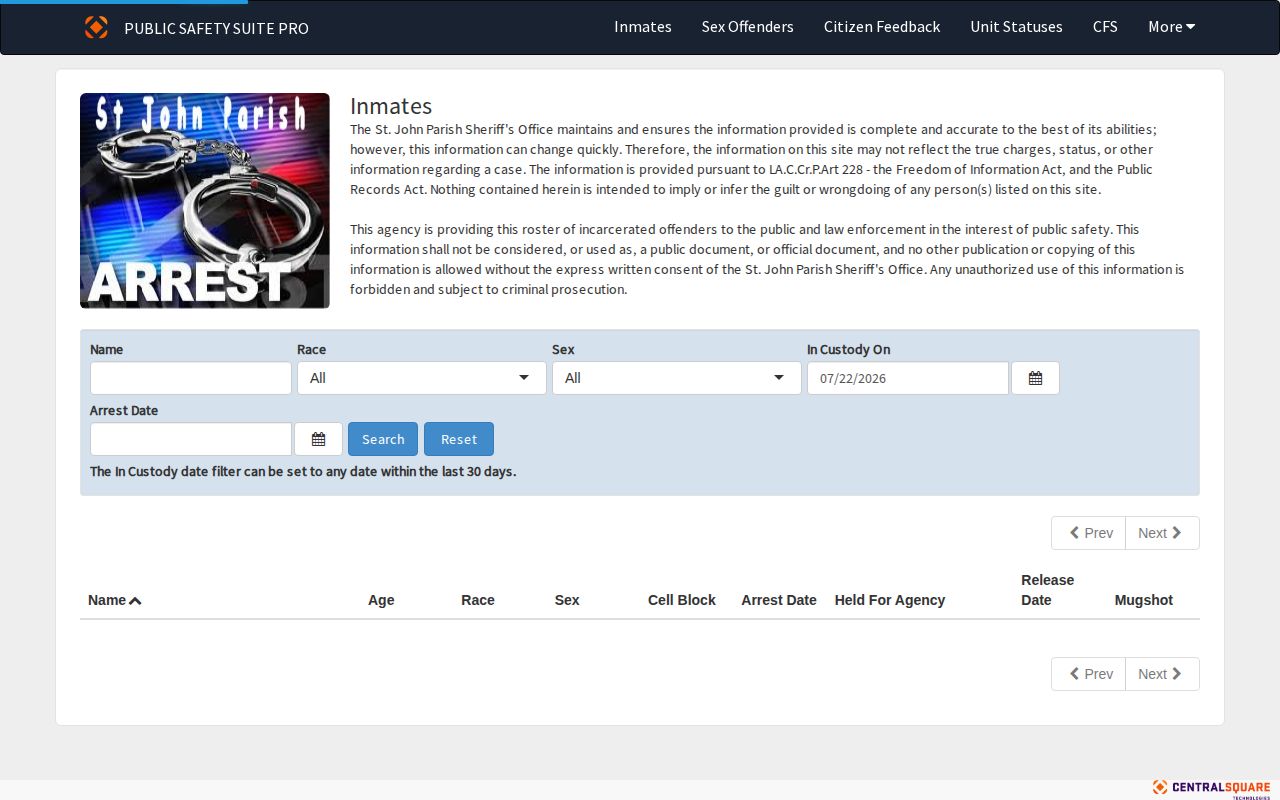
The captured roster supports using its mugshot and release-date columns together while keeping the portal’s historical-search limits in view.
St. John Mugshot Release Pairing
St. John’s roster has an unusual strength. The same row can combine a mugshot with a later release date when the person is found through the historical custody-date control. Preserve the exact timestamp, local UTC offset, query date, arrest date, and held-for agency. Those fields help distinguish a true match from a namesake and show which custodian recorded the event.
The result still has firm limits. A release timestamp may reflect bond, time served, dismissal-related processing, transfer, detainer action, or another closure. The public portal does not show the reason or destination. “Held For Agency” is especially important at Lt. Sherman Walker Correctional Facility because the jail holds both parish and state inmates. A row tied to Louisiana Department of Corrections may record movement to another state facility, not release to the community.
For a named person, use the St. John 24-Hour Releases method to understand why the prior-date search is a retrospective lookup rather than a complete rolling feed. Call the Booking Desk when the event is recent. For a durable record, ask Records for the release authority, type, and receiving agency alongside the photograph.
Note: The roster’s 30-day historical reach is a search limit and does not establish when the underlying booking photo is destroyed.
St. John Sheriff Mugshot App
The official “St John Sheriff” app is free for Apple and Android. The Sheriff confirms inmate and warrant research, crime mapping, tips, and push alerts. Those are useful official functions for checking a current person or another public entry. The published source does not confirm a recent-release screen or a released-mugshot archive. Do not infer either feature from a generic inmate-search description.
The Sheriff’s app announcement is the source for the verified app capabilities.
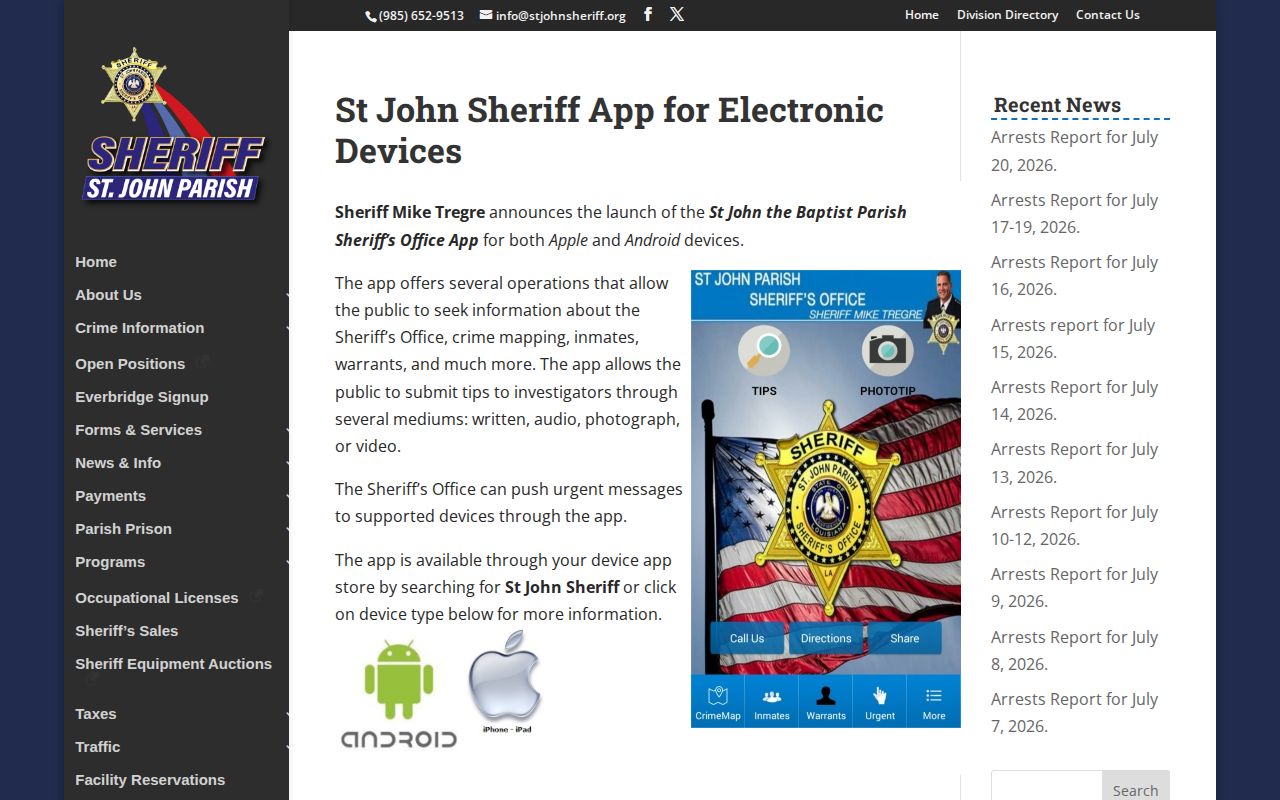
The official announcement supports inmate and warrant research but does not justify describing the app as a complete release-photo gallery.
If the live app displays a photo, match it with booking identifiers and a separate release record. App content can change. Record the date checked and do not carry an old feature claim forward without confirming it in the current version. A push alert also does not replace the custodian’s release sheet or the court’s disposition.
Request St. John Booking Photos
A written records request is the durable route when the roster no longer displays the booking or a formal copy is needed. Send the request to the St. John the Baptist Parish Sheriff’s Office Records Division. Include full name, date of birth, approximate booking and release dates, and the CCN or court number if known. Ask for the booking photograph and the matching booking/release record in the same request. That keeps the image tied to its event.
- Review the Sheriff public-records instructions and identify the person and booking as precisely as possible.
- Request the booking photograph, actual release date and time, release type or authority, and destination or receiving agency if transferred.
- Ask for segregable nonexempt portions and the legal basis for any withheld part.
- Request an electronic estimate and confirm the delivery medium before paying. A published disc charge may not be needed for one image.
- Compare the returned photo and identifiers with the release sheet and 40th JDC case record.
Sheriff Records Division
Address:
Percy Hebert Building
1801 West Airline Highway
LaPlace, LA 70068
Mail: P.O. Box 1600, LaPlace, LA 70069
Email: records.request@stjohnsheriff.org
Phone: (985) 359-8873
The published schedule lists a $10 record check, a $50 CD containing photographs or videos, printed records up to five pages at $25 plus $1 for each later page, and $10 mailing, with prepayment required. Ask whether one photograph can be sent electronically and obtain an exact estimate. Investigative, juvenile, victim, security, or other protected material may be redacted or withheld.
If the response includes only the photograph, ask whether the nonexempt booking and release identifiers can be supplied as well. A loose image is easy to mislabel. The useful record connects the photo to the named booking, identifies the custodian, and shows the later release fact or points to the record that does.
Note: Louisiana’s five-day rule concerns a custodian’s written determination, not a promise that every photo request will be completed in five days.
St. John Arrest Photos Differ
The Sheriff also maintains dated arrest reports. An arrest report can preserve an image or identify a booking, but it documents entry into the process. It does not prove release, guilt, dismissal, sentence completion, or current custody. Use it as a discovery clue, then locate the jail release timestamp and the court disposition.
The official St. John arrest-report archive illustrates that separate arrest-side channel.
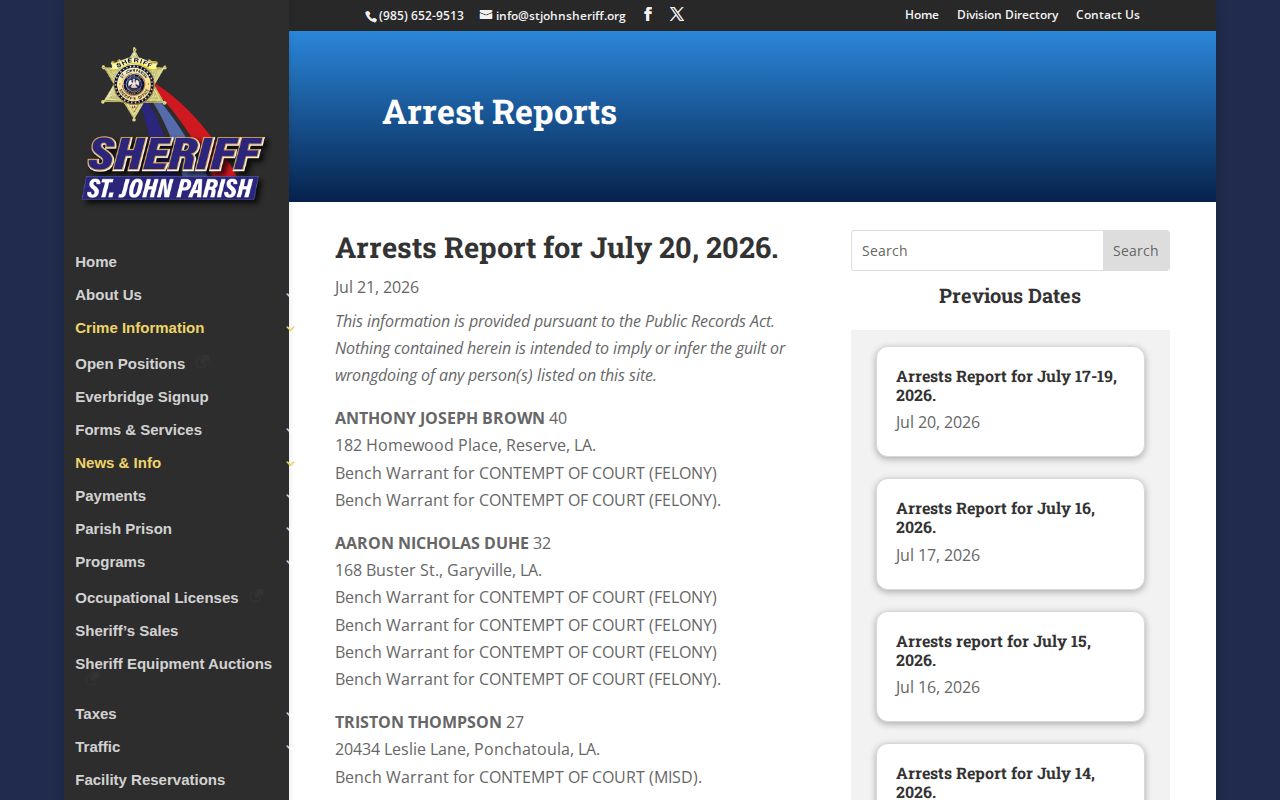
The captured archive helps locate dated arrest material, but its entries must be paired with current release and disposition records.
Nonofficial photo archives and news reports can retain older images. Treat them only as secondary discovery channels. Do not rely on a commercial mugshot publisher for release status, and do not pay or endorse a removal broker. The official Sheriff, court, and statutory channels provide the source record and correction path.
St. John Mugshot Expungement
Expungement changes public access. Louisiana Code of Criminal Procedure article 972 defines it as removing covered arrest and conviction records, including photographs, fingerprints, and disposition, from public access without destroying them. Article 973 generally makes an expunged record confidential, subject to statutory exceptions. A missing image after an expungement cannot prove that no booking or release occurred.
Eligibility is case-specific. Article 977 and article 978 contain misdemeanor and felony pathways, timing requirements, exclusions, and conditions. The Clerk of Court holds the controlling case record and any expungement order. Do not reduce the rules to a single waiting period. Verify the current statute and signed order, then send the official source a focused request that identifies the protected record.
Current article 234 addresses covered remove-for-pay sites. After a qualifying outcome such as acquittal, no prosecution, expungement, vacation, or pardon, a covered publisher must remove and destroy the booking photograph within seven calendar days after a proper request and proof, and it may not demand payment. R.S. 14:133.7 also addresses confidential juvenile material, notice of expungement or nondisclosure, fees to remove or correct published criminal history, and continued incomplete or inaccurate publication.
For an official correction, give the Sheriff or Clerk the case number, booking identifier, and signed order. For a nonofficial publisher, use its accessible dispute contact and provide the qualifying proof the current statute requires. A photograph should always retain its date, source agency, and verified disposition context while it remains lawfully public.