
St. John Parole and Probation
A person can leave confinement and still answer to the Louisiana Department of Public Safety & Corrections. Parole is conditional release from a prison term under rules tied to that sentence. Probation is a court-ordered period of community supervision, often imposed instead of all or part of a jail or prison term. A split sentence combines confinement with probation. Louisiana also has earned-time releases that may carry supervision, and the applicable rule depends on the offense date and statute.
That distinction controls the record trail. A parole record begins with the sentence, any eligibility rule, a Committee on Parole action where required, and the actual release. Probation begins with the 40th Judicial District Court sentence or later order. The Division of Probation and Parole supervises both felony probation and parole in St. John the Baptist Parish. The state search may identify the assigned district, while the court docket explains why probation exists.
| Question | Parole | Probation |
|---|---|---|
| Who creates the status? | State law and, when required, the Committee on Parole | The sentencing court |
| What comes first? | A prison sentence and release from confinement | A court judgment, sometimes after a short jail term |
| Best starting record | LA VINE, the DPS&C locator, and parole docket material | The 40th JDC sentence and the assigned P&P district |
| Does it prove jail release? | No. Confirm the actual exit with the custodian | No. Confirm that release processing was completed |
- Parole
- Conditional release from a sentence under stated rules.
- Probation
- Court-ordered community supervision that follows a judgment.
- Discharge
- The formal end of a sentence or supervision term.
- Absconder
- A supervised person alleged to have stopped reporting or left supervision without approval.
Verify St. John Post-Release Supervision
Begin with identity, not a name alone. Louisiana Person Search accepts a name or ID/case number and can include people under probation or parole community supervision. A Probation and Parole district in the result is a strong lead that the person is no longer in a state institution, but the district should confirm the public status it can release. A state facility location means the person remains confined. Neither result proves what happened in a separate parish-jail case.
For a St. John the Baptist Parish court case, compare the state result with the 40th JDC docket. Look for the sentence, probation order, revocation, or later discharge. If the person was held at Lt. Sherman Walker Correctional Facility, the local release timestamp shows an exit from that jail-management event. It does not say whether the destination was the community, another jail, or state custody. The St. John the Baptist Parish released-inmate search path explains how the local roster and court record fit together.
- Open Louisiana Person Search. Choose a name or ID/case-number search and enter the most reliable known identifiers.
- Compare age or date of birth, identifier, reporting agency, and location. Do not select a namesake based on spelling alone.
- Read the location carefully. A P&P district suggests community supervision; a correctional facility means continued state confinement.
- Check the 40th JDC record for the sentence or probation order. For parole, use the official Board docket and decision channels.
- Call the assigned district and ask for public confirmation of office assignment and current supervision status. Protected case details may not be disclosed.
- Verify the actual jail or prison exit with the agency that held the person. Supervision data does not replace the release record.
LA VINE can also support a specific-person check and, where offered, notification registration. A custody-change alert shows that the reporting agency sent an event; it does not certify the release type or supervision standing. Louisiana’s separate LAVO process serves eligible victims or designated people seeking formal state notices. General LA VINE registration does not replace LAVO registration.
Note: The DPS&C online search is described as updating every 24 hours, so urgent status questions require direct agency confirmation.
St. John Supervision Office
The Donaldsonville Probation and Parole District serves St. John the Baptist Parish along with Ascension, Assumption, and St. James parishes. It is the primary state office for verifying which district supervises a released St. John person. DPS&C materials state that a supervised person must report to the specified district within 48 hours of sentencing or release. That reporting rule should not be used to calculate when the jail will open its doors. P&P officers supervise after release; they do not set the physical release time.
Donaldsonville P&P District
Address:
10115 Frontage Road
St. James, LA 70086
Phone: (225) 474-2020
Coverage: St. John the Baptist Parish and three neighboring parishes
The official Donaldsonville district listing is the best source for current contact details and any offsite schedule. Call before traveling. A public locator result may identify an assigned district, but some supervision data, including medical or testing details, is confidential. A focused status request should ask whether the office assignment is correct and what public verification is available, not for protected case notes.
The official Donaldsonville district page shows the local supervision arrangement.
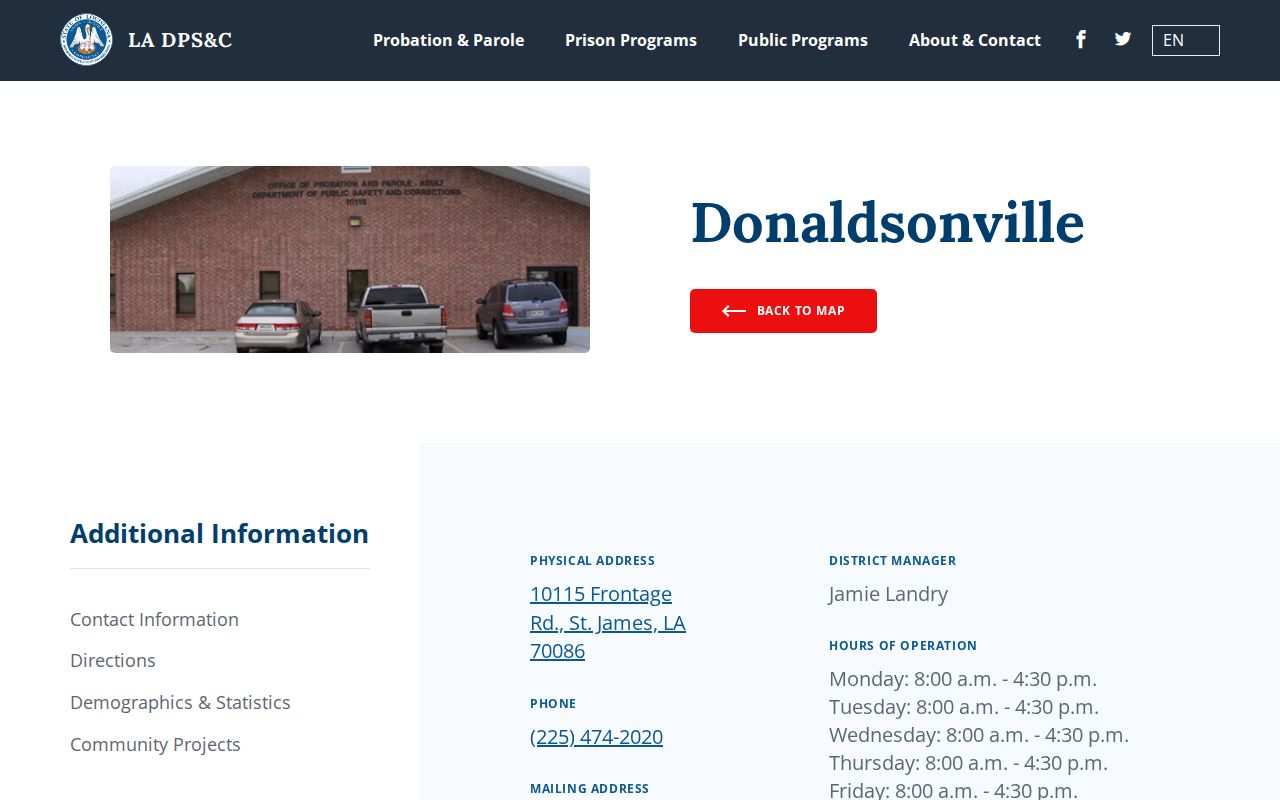
The captured listing ties St. John the Baptist Parish to the Donaldsonville District and supports checking its current contact details before a visit.
St. John LaPlace Reporting Window
St. John has a distinctive offsite option. The Donaldsonville district page lists a LaPlace presence at the Acuri Center on the first Tuesday of each month from 10 to 11 a.m. That narrow window can help explain why a state office outside the parish still serves local supervision needs. It is not a general walk-in promise for every question, and it is not a release pickup location.
Call the Donaldsonville District before using the LaPlace window. Schedules can change, and the correct office may depend on a specific assignment. Bring or have the DPS&C number, full legal name, date of birth, and any court case number available. Those facts help staff distinguish the correct record. The offsite schedule comes from the official district listing; it does not expand what confidential information the office may disclose.
Note: The Acuri Center schedule is a supervision-office detail, not proof that a person has reported or completed release processing.
St. John Release and Warrants
Release status and warrant status answer separate questions. The parish roster may document that a person left one custody event. The St. John Sheriff active-warrant portal may show a different matter. A person can be released on bond or after sentence credit while another warrant remains active. The reverse is also true: absence from the public warrant portal does not certify compliance with parole or probation.
An absconder is a supervised person alleged to have stopped reporting or left supervision without approval. A state parole or probation warrant should be confirmed with DPS&C. Do not infer it solely from the parish warrant list. When records disagree, note which agency created each entry and the time checked. Ask the supervising district about the state status and the Sheriff about the parish warrant. If a warrant leads to a new arrest, that new custody event is distinct from the earlier release.
St. John Parole Hearing Records
Parole eligibility, a scheduled hearing, a panel decision, and actual release are distinct events. The Louisiana parole schedules and dockets page leads to the live Committee on Parole docket. The state guidebook says parole dockets update at noon Monday through Friday and remain subject to change. A docket commonly identifies the imprisoned person, DPS&C number, hearing location, judicial district, start time, and meeting details.
A hearing can result in a grant, denial, deferral, or rescission, depending on the proceeding. The official parole-decision policy explains agency entry of decisions, but research did not establish a separate current public database searchable for all outcomes. Check the live docket close to the hearing, use the official viewing route when available, and contact the Board at (225) 342-6622 or paroleboard@la.gov for an eligible public record. A grant still requires processing.
Eligibility rules vary sharply by offense date and category. R.S. 15:574.22 removes parole eligibility for many post-August 2024 commitments except listed R.S. 15:574.4 categories. Older percentage rules carry exclusions. Never turn an eligibility fraction into a personal release forecast. Confirm physical release through DPS&C or LA VINE, and check the Sheriff record when a state prisoner was housed at Sherman Walker.
St. John Supervision Conditions
Conditions are the rules attached to supervision. They may require reporting, lawful conduct, residence or travel approval, and compliance with instructions set by the court, parole authority, or supervising officer. The DPS&C supervision brochure describes the agency role and reporting framework. Exact terms come from the judgment, certificate, or supervision record and should not be guessed from a locator result.
A violation allegation is not the same as a final revocation. The court handles probation revocation, while the state parole process handles parole matters under its authority. A warrant may result, but the public parish portal is not a complete state absconder system. For purpose-neutral verification, record the supervision source, assigned district, court or DPS&C number, and the date of contact. Seek the controlling order if a legal process needs formal proof.
St. John Supervision Discharge
Supervision ends through a formal discharge, expiration, court action, or another result authorized by the controlling sentence and law. Discharge means the supervision term has ended. It is different from the earlier release from a jail or prison. A person may have a jail release date, a projected state release date, a parole or probation start, and a later discharge date. Each is a separate event.
For probation, look for a 40th JDC entry that closes or changes the term. For parole or another DPS&C status, ask the assigned district what public proof of discharge is available. Louisiana’s earned-time laws also matter. Newer qualifying diminution releases can lead to unsupervised parole for the rest of the full term, while legacy diminution law can treat release as if on parole with conditions and supervision. The offense date and statute determine the correct path.
If the public search stops returning a record, do not call that discharge. A missing result can reflect retention, spelling, data lag, transfer, sealing, or scope. The durable proof is the state or court record that identifies the end of supervision. Preserve that record with the earlier custody-release evidence when the full timeline matters.
Note: Parole eligibility, a favorable hearing result, actual release, and final supervision discharge are four distinct milestones.